
Special Offer Coming Soon
The Origin and History of Ayurveda: Ancient Healing Wisdom from India
Ayurveda, often described as the “Science of Life,” is one of the world’s oldest holistic healing systems, originating in the Indian subcontinent over 5,000 years ago. Rooted in the ancient Vedic culture, Ayurveda integrates spiritual, philosophical, and empirical medical knowledge, making it a profound legacy of Indian civilization.
Vedic Roots of Ayurveda
Ayurveda is deeply connected to the Vedas, the oldest sacred scriptures of Hinduism, particularly the Atharva Veda. The Atharva Veda contains hymns, prayers, and formulations focused on healing diseases and promoting health. Ayurveda is considered an Up-Veda — a specialized branch or supplement — to the Atharva Veda, underlining its revered position in the traditional knowledge system.
Mythological Origins: Knowledge from the Gods to Sages
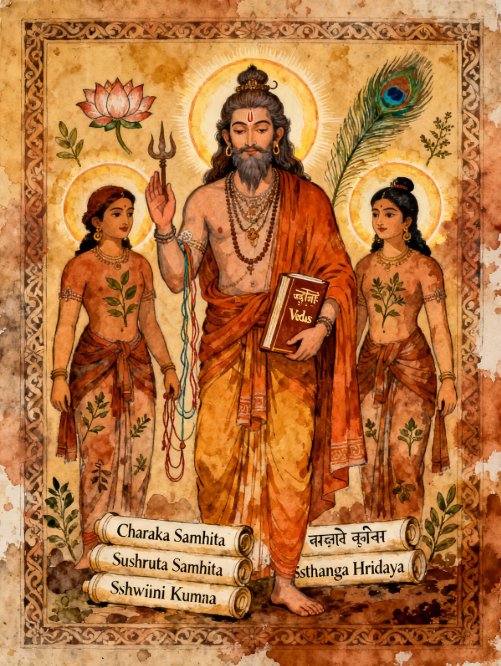
According to Hindu mythology, Ayurveda’s knowledge was divinely created by Brahma, the creator god. This sacred wisdom was passed to a divine lineage that includes Daksha Prajapati, the Ashwini Kumaras (the physician gods), Indra (king of gods), and Bharadwaja, before finally reaching human practitioners. This divine inheritance underscores Ayurveda’s holistic and spiritual framework.
Classical Sanskrit Texts: The Foundation of Ayurvedic Knowledge
The systematic articulation and expansion of Ayurvedic principles occurred during the Samhita period, roughly from the 6th century BCE to the 7th century CE. Key classical texts from this era are:
• Charaka Samhita: Compiled by Maharishi Charaka, this text lays the foundation for internal medicine (Kaya Chikitsa). It discusses diagnostic principles, treatment methods, and the concept of balance between body, mind, and spirit.
• Sushruta Samhita: Authored by Sushruta, regarded as the “Father of Surgery,” this work describes surgical techniques, instruments, and procedures (Shalya Tantra). It provides detailed knowledge on anatomy and various surgical operations.
• Ashtanga Hridaya: Written by Vagbhata, this text synthesizes the teachings of Charaka and Sushruta and offers a comprehensive guide to Ayurveda that continues to influence practice today.
The Evolution and Influence of Ayurveda
Ayurveda developed further over centuries, evolving from early Vedic concepts to a sophisticated medical science encompassing eight branches, including internal medicine, surgery, pediatrics, toxicology, and rejuvenation therapies. With influences from ancient Indian philosophies like Nyaya and Vaisheshika and its holistic approach to body, mind, and spirit, Ayurveda has impacted other traditional medicine systems across Asia.
Evidence also suggests that Ayurvedic ideas may have origins in the Indus Valley civilization predating Vedic times, though the undeciphered script leaves some details unknown.
Ayurveda Today: A Timeless Science of Life
Despite its ancient roots, Ayurveda remains widely practiced in India and worldwide as a system of preventive and curative care, emphasizing balance through diet, herbal medicines, lifestyle, and spiritual well-being. Modern natural healing systems, including some Western approaches, trace their origins back to Ayurvedic principles.